One pane of glass for NetScaler, XenServer, Hyper-V and Windows.
One live view of your Citrix and Windows estate, with verdicts that say what is wrong and why, analytics that show where users are struggling, and, where you license it, the controls to fix it from the same page. Installs in minutes on one Windows server. Sends nothing to the cloud on its own.

Who it is for — bought direct, or through the MSP that runs your estate
You run your own estate
A university, a hospital, a company with its own NetScaler pairs, XenServer pools, Hyper-V hosts and Windows servers, and a team that has to answer "why did that fail" before the next meeting. One install on a Windows server you own, the modules you need, a key bound to that installation, verified offline, renewed yearly.
- Verdicts, not graphs. Every pool, pair and server says what is wrong and why, in words.
- Nothing leaves your network unasked. No agents on hypervisors, no cloud relay. The portal is contacted only when you press Activate or Check for updates, or switch on the company's Uptime page.
- Start with reading, add management. Monitoring modules first; consoles and configuration when you want them, on the same install.
You run estates for others
Sold to managed service providers as a pool: you buy units per module at your tier's price and issue keys to your own clients from the licensing portal, each installation on its own record. The dashboard runs inside each client's network, so their data never leaves their site and never touches yours.
- Your margin, your keys. Three partner tiers; keys issued from your pool in minutes, bound to the client's Installation ID so a key cannot walk.
- Reports your clients can read. NetScaler, XenServer, Windows and uptime reports as PDF, in words a non-engineer follows.
- Same page at every client. The one console, the same verdicts and the same audit line, so a technician who knows one knows all. An NFR key for your lab.
Multi-tenant views and per-site roles on one instance are on the roadmap; today it is one install per client.
Explore — the products, as the dashboard's own tiles
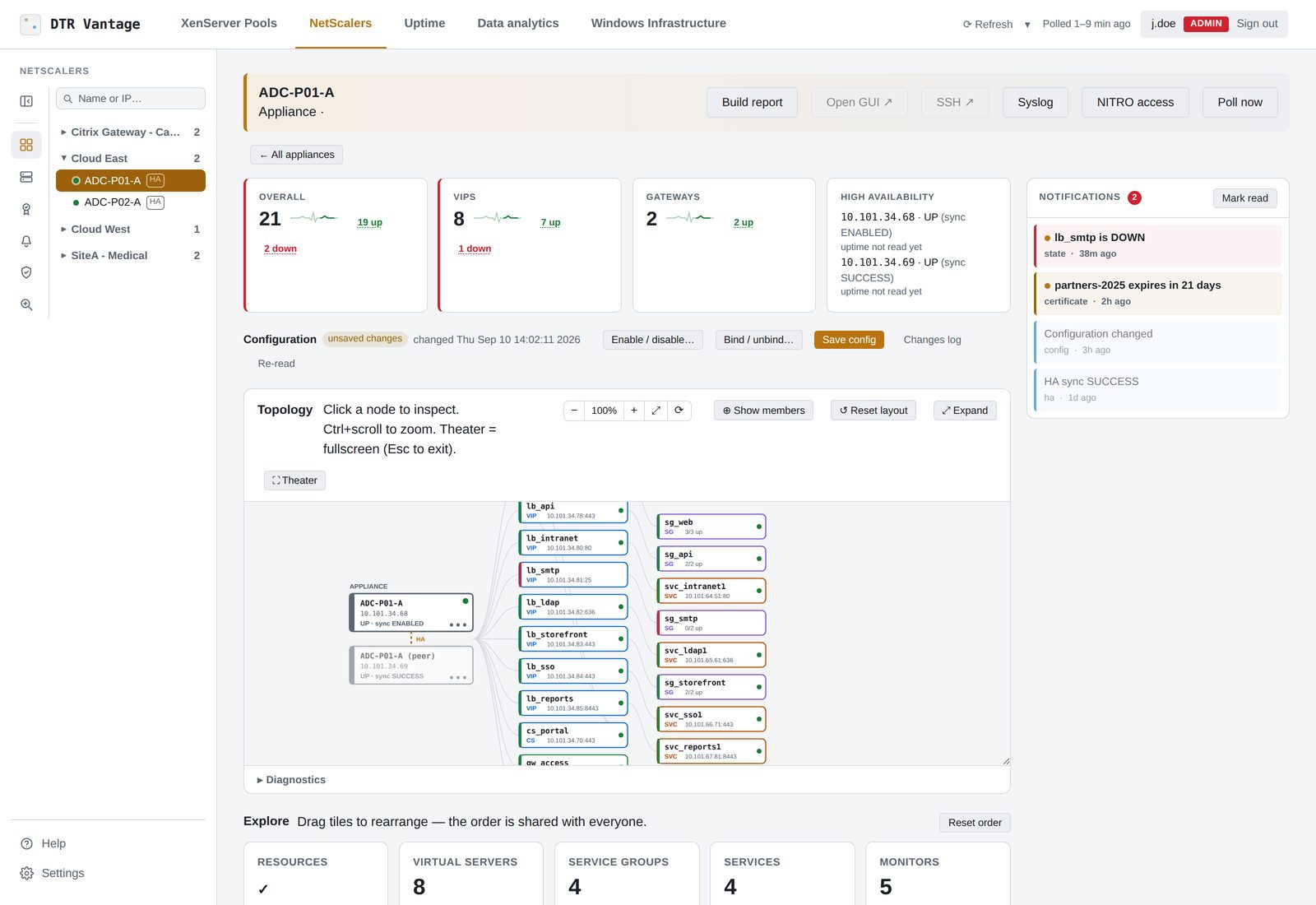
NetScalers
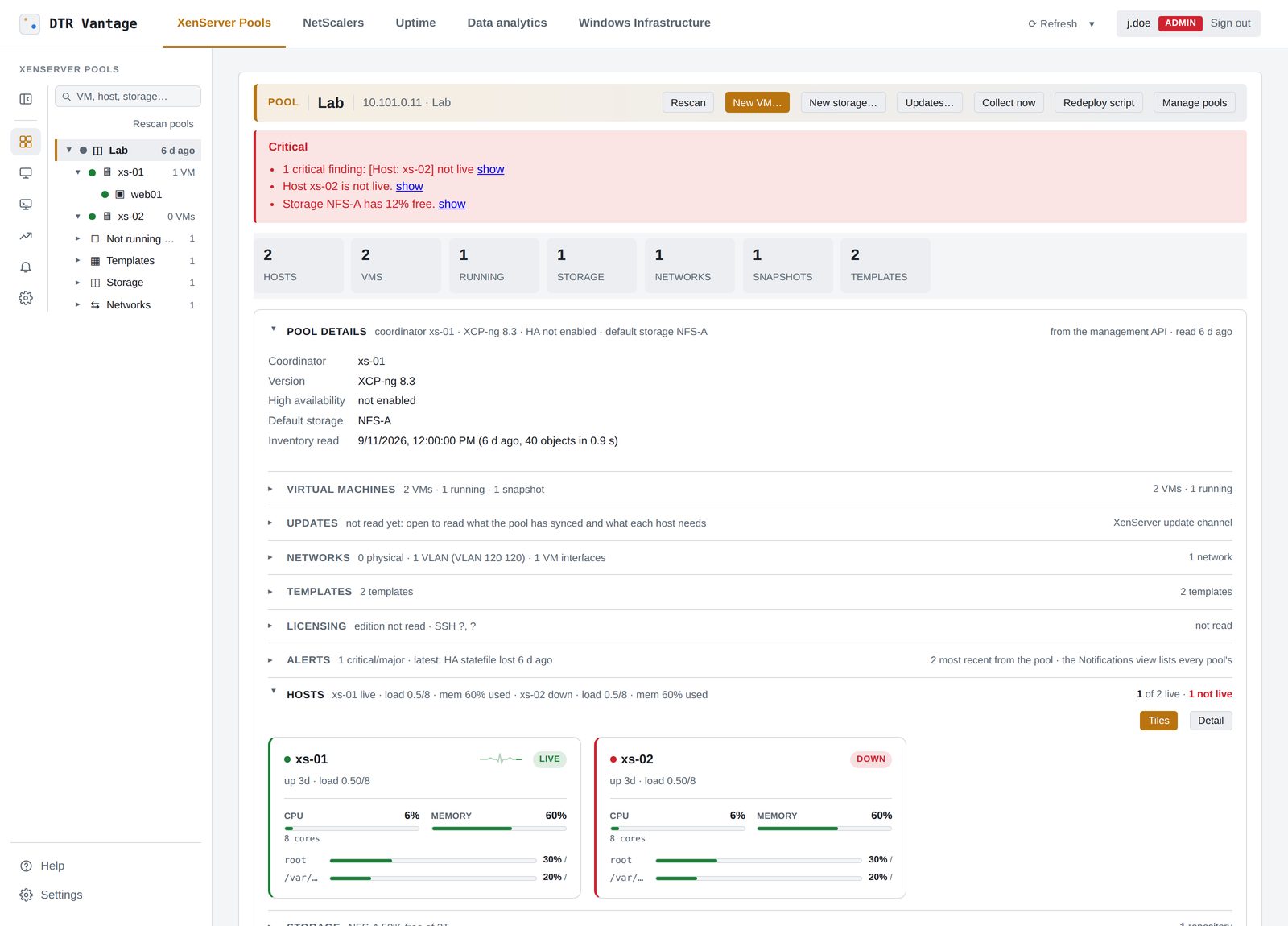
XenServer
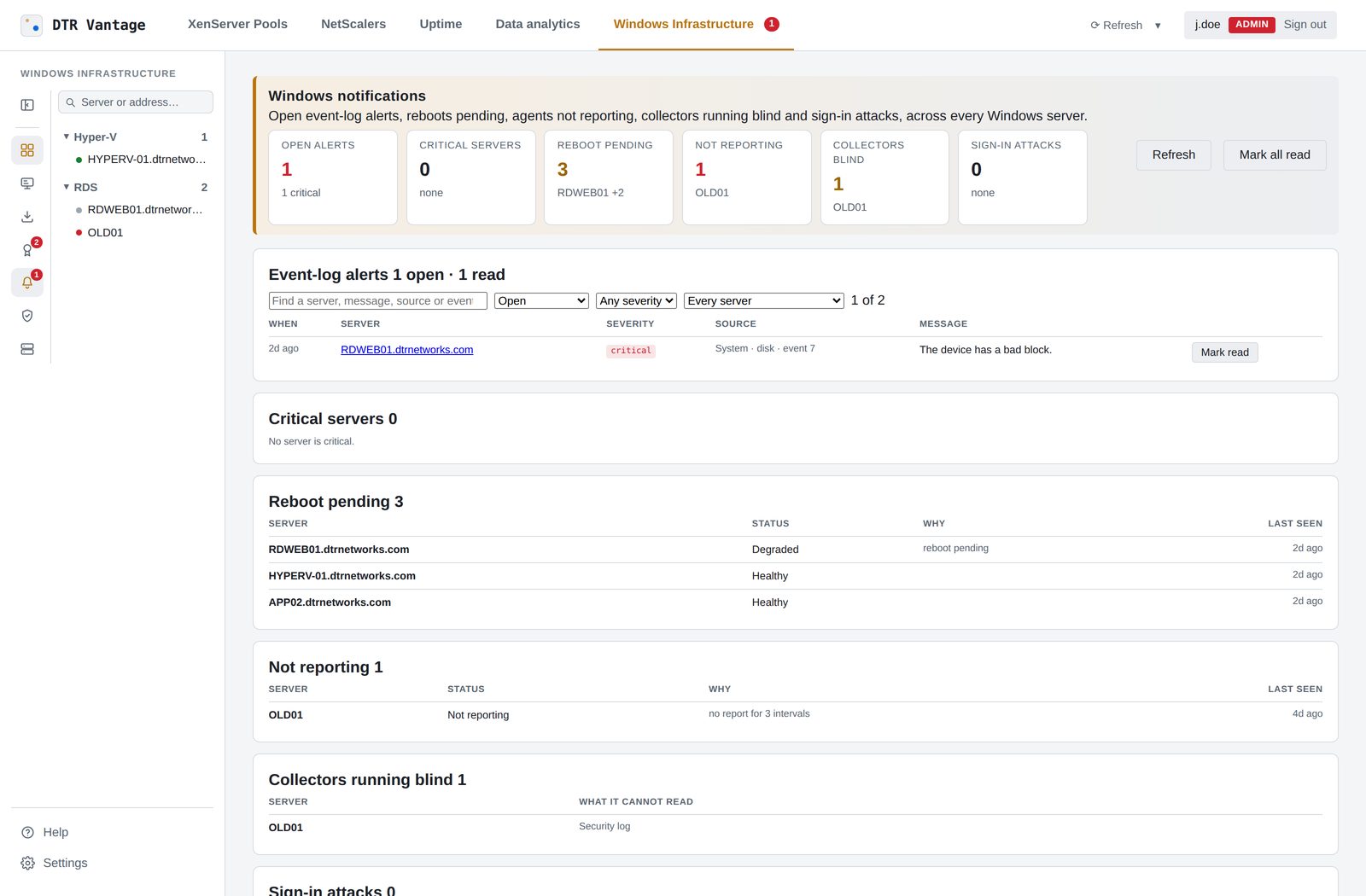
Windows & Hyper-V
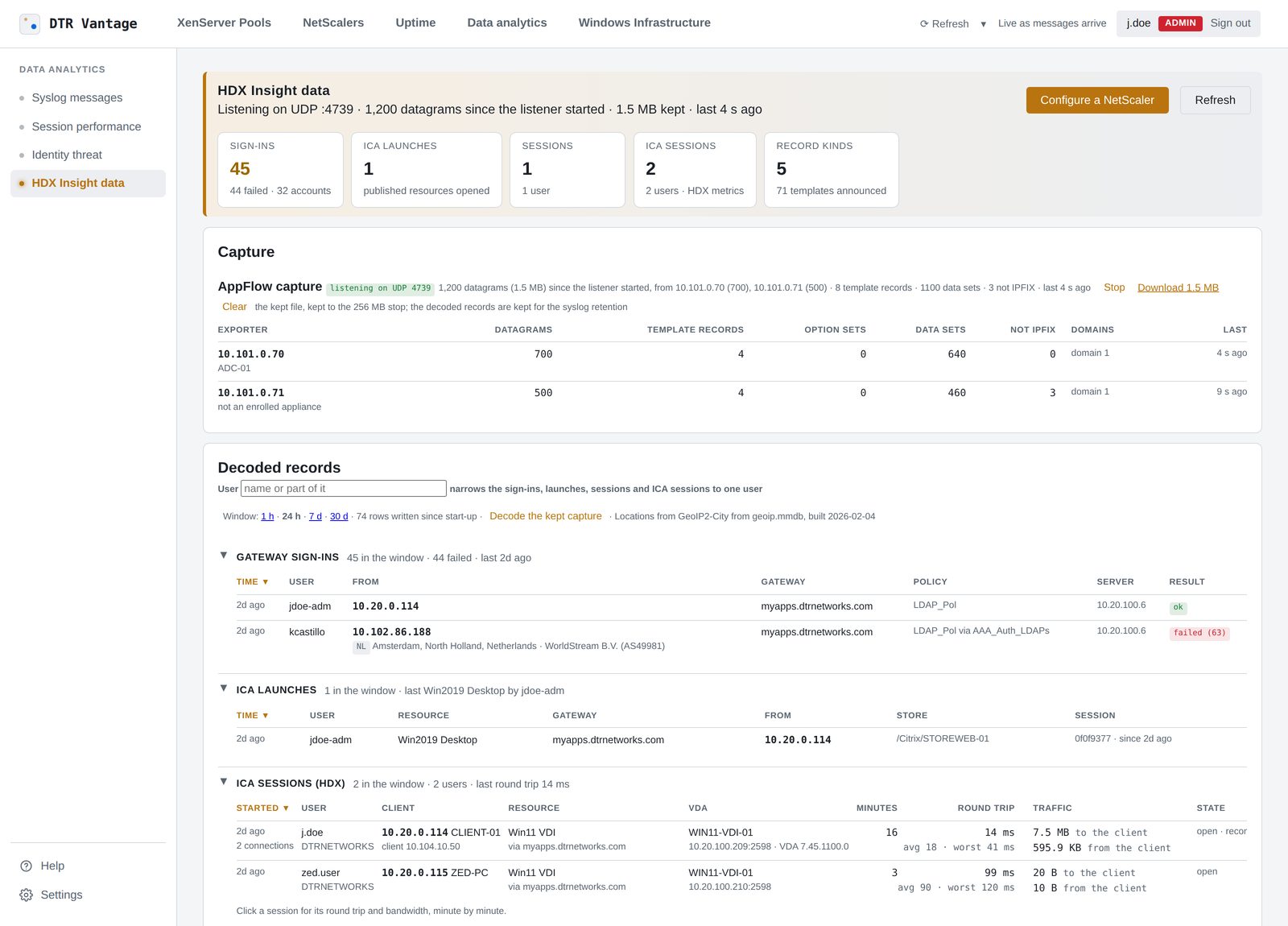
Data analytics
The first central, browser-based console for XenServer
Citrix ships XenCenter as a Windows application, one per administrator. DTR Vantage puts XenCenter’s operations in the browser, for every pool, for every operator, with roles and an audit line on every action. No client to install, no root password handed around.

XenCenter, without XenCenter
The pool tree with hosts, VMs, templates, storage and networks; every VM operation, the properties dialog, the wizards, host updates; and the VM’s screen. All of it from the same sign-in as the rest of Vantage.
| XenCenter | The Vantage console | |
|---|---|---|
| Where it runs | A Windows application on each administrator's PC | ✓One URL, in the browser, for every operator |
| Pools | One XenCenter connects to the pools it was told about | ✓Every enrolled pool in one tree, kept live by the pool's own event stream |
| Who did what | Not recorded centrally | ✓Every action is a task with its outcome in the pool's words, and an audit line with who |
| Roles | Whoever has the pool's root password | ✓Viewer, operator, administrator; data-destroying actions and host power are admin only |
| The VM's screen | VNC inside the application | ✓VNC in the browser: mouse capture, Send text, typed fix recipes, Detach to its own window, hand-over when two people are on it |
| Host updates | Install Updates wizard, one XenCenter at a time | ✓Applied host by host from the page, with the log, as a task you can cancel between steps |
| Credentials | Stored in XenCenter on the PC | ✓One per-pool API credential, encrypted on the server; the coordinator's certificate pinned before it is sent |
The topology, live
The appliance page draws every virtual server, service group and member as the configuration binds them. This one is the real thing: hover a node, click it to focus its path, show the members.
Analyze: a verdict, not a log
Ask why an appliance restarted and get an answer with its confidence and evidence, from both nodes' clocks, the syslog held on Vantage, the appliance's own audit log, crash dumps and the previous run's event log. Pick a scenario.
See
Every NetScaler pair, XenServer pool and Windows server on one page, with a verdict and its reasons that open the row they name. Every panel says when its reading was taken and what it could not read.Understand
Analyses that answer the question an operator actually asks: why did it restart, why did it fail over, is anything climbing. HDX Insight and session performance show where users are struggling.Act
Where licensed, the changes you would make in the ADC GUI, XenCenter or Hyper-V Manager, from the same page, as yourself, every one audited. Reading is the default; management is sold apart.What is stored, and what is not
| Credential | Stored? | How it is used |
|---|---|---|
| The operator's password | never | Typed per action, held in memory, handed to the child over stdin, never on a command line. The audit line records the username and "credential not stored". |
| The per-server agent secret | shown once | Returned by exactly one endpoint at enrolment, never by a read endpoint; reports are HMAC-signed. |
| Appliance and pool accounts | encrypted | Encrypted with a machine-local key, never returned by a read endpoint. Certificates are pinned by SHA-256 before a credential is sent; a changed certificate is never re-learned on its own. |
| NetScaler changes | separate account | Monitoring reads with a read-only account; configuration uses a separate read-write account that exists only where the configuration module is licensed. |
| The agent | least privilege | A shared service account that is deliberately not an administrator, so a password stored for monitoring is not a password worth stealing. |
Where it sits
One Windows Server VM with IIS in front. Nothing is installed on the appliances or pools; one small agent per Windows server. Sign in with LDAP or Active Directory, with viewer, operator and administrator roles. Licence keys are files bound to the installation; the licensing portal issues them online where you have internet, and by hand where you do not. Updates are checked, downloaded and applied from the dashboard's own License and updates tab.